Brazilian Pavilion – Venice International Architecture Biennale 2025
BUILT
VENICE, ITALY, 2025
(RE)INVENTION
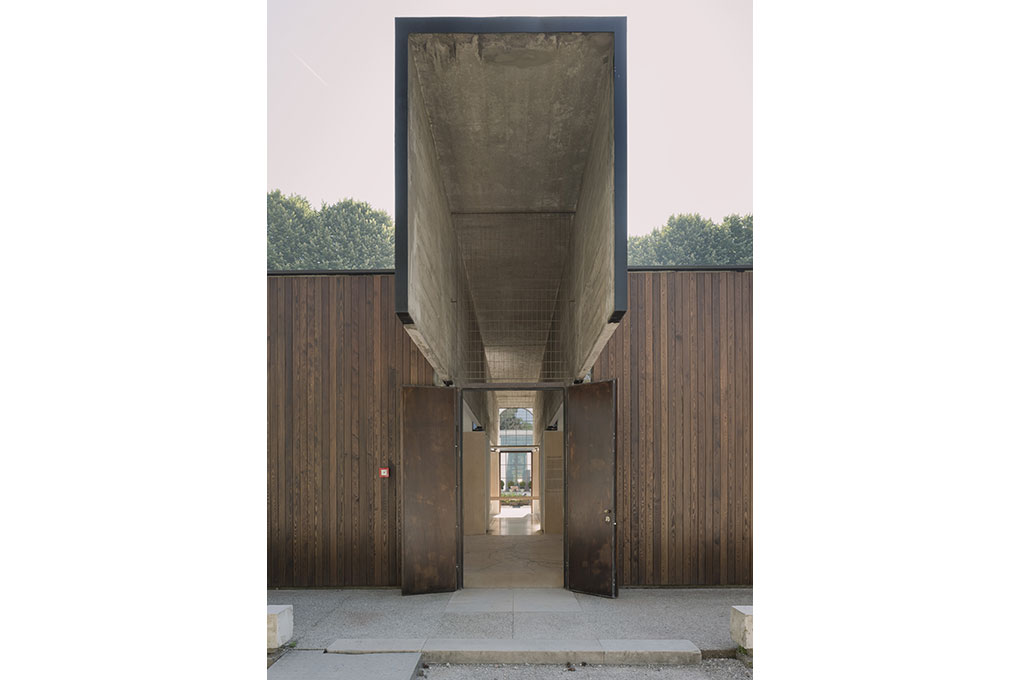
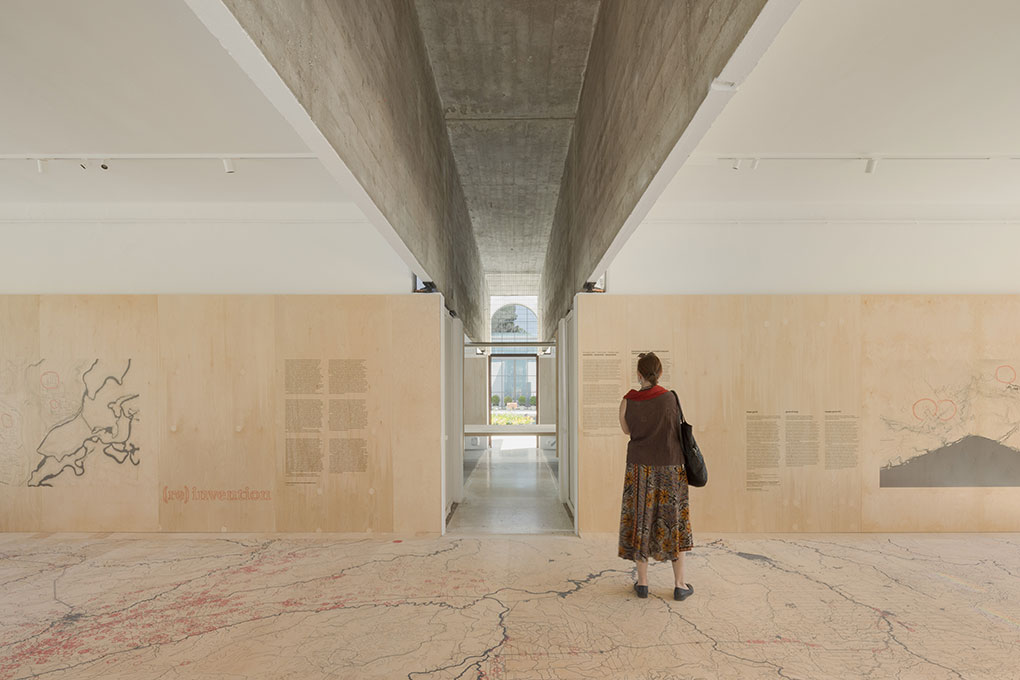
The curatorial and exhibition design project for the Brazilian representation at the 19th International Architecture Exhibition – La Biennale di Venezia, originated from the winning proposal submitted by Plano Coletivo, a gorup of which BLOCO is a member, in the competition organized by the Fundação Bienal de São Paulo. The installation occupied the Brazil Pavilion in the Giardini in Venice for six months. The exhibition proposes a reflection based on recent archaeological discoveries of ancestral infrastructures in the Amazonian territory, articulating them with the contradictions and socio-environmental conditions that shape the contemporary city. Structured in two acts, the exhibition (RE)INVENTION builds a narrative that traverses time and territory.
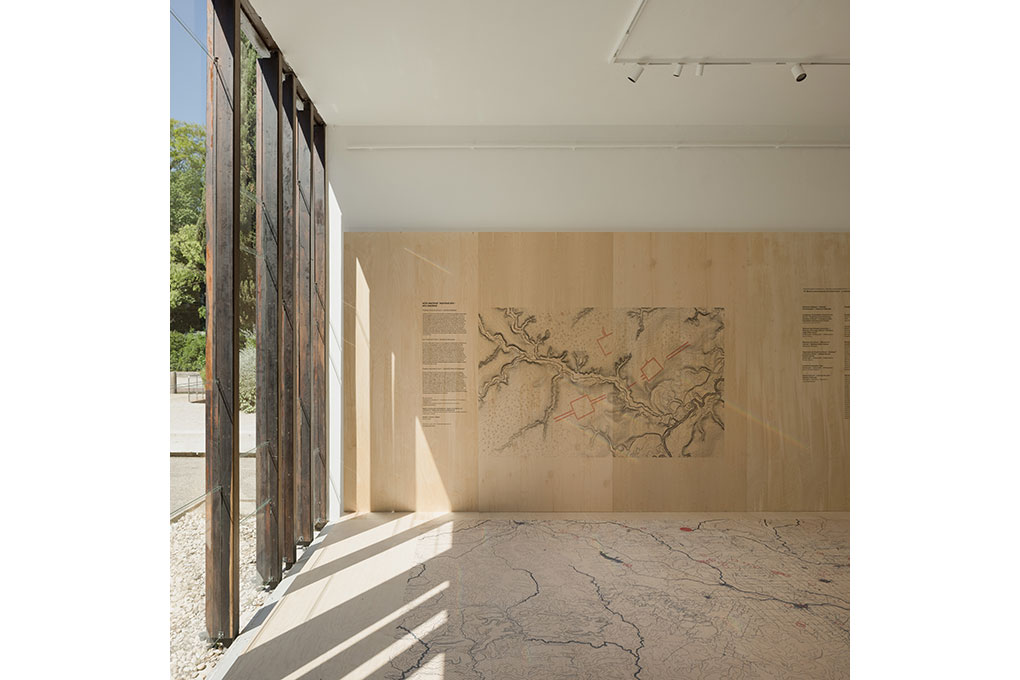
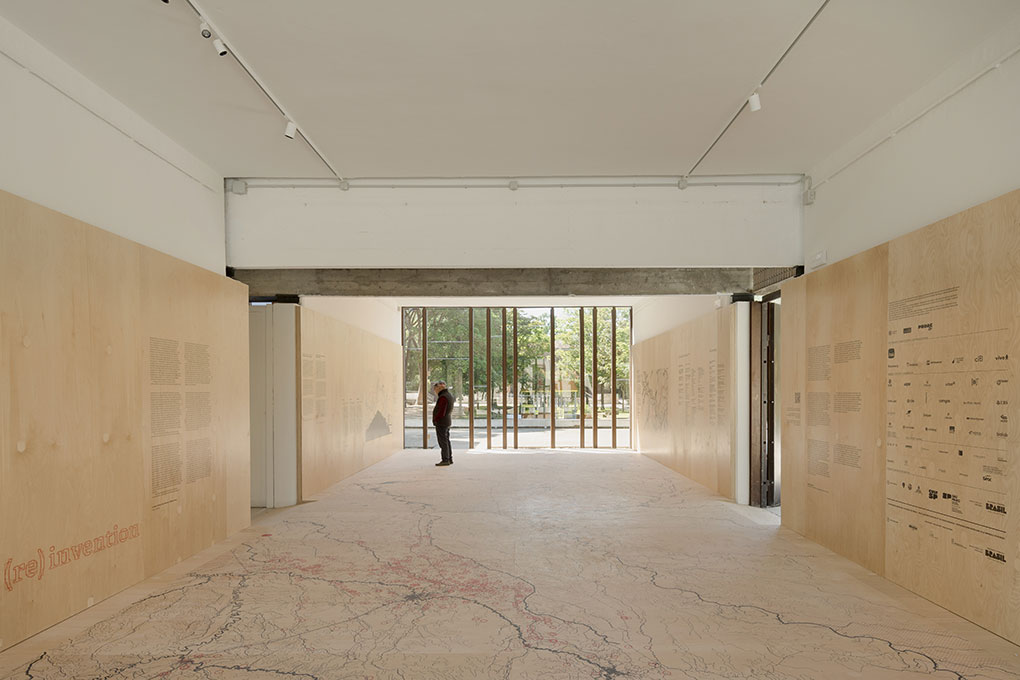
The first act occupies the smaller gallery of the Brazil Pavilion and presents narratives of ancestral Brazil that invite us to reconsider, in light of recent archaeological studies from the Central Amazon, the true age of Brazil’s “inhabited forest.” Approximately 10,000 years ago, since the beginning of the Holocene, Indigenous peoples occupied the lowlands of South America and shaped the surrounding landscapes, creating sophisticated infrastructures that integrated technical knowledge and environmental adaptation strategies. The occupation of this region is therefore as ancient as that of other Amerindian peoples. From the ground itself, earthworks, embankments, retaining walls, and large-scale structures were constructed to shelter thousands of inhabitants. The significant anthropogenic transformations resulting from this occupation established adaptations within nature and produced new landscapes. The Amazon rainforest can thus be understood as the outcome of a balanced coexistence between humans and nature.
The second act occupies the larger gallery of the pavilion and proposes to present design strategies that challenge everyday life in pursuit of social equity and ecological balance in contemporary Brazil, a country shaped by an exceptionally rich natural and urban heritage, born from the promise of development and the desire for cultural emancipation. The focus turns to the possibility of recognizing and valuing design strategies and operations “encapsulated” within the ingenious existing production, inherited and appropriated. Complex yet unequal; useful yet limited: this is our “inherited infrastructure.” The aim is not to recover the image or aesthetic principles of exemplary projects from the past, but rather to update the problem, to hold it in suspension in order to consider contradictions, question the socio-environmental conditions of the contemporary city, and present possibilities for learning and action in the face of future challenges. What lessons, in terms of relevance and meaning, can be drawn from the relationship between this infrastructural built heritage and natural heritage?
Exhibition Installation Concept
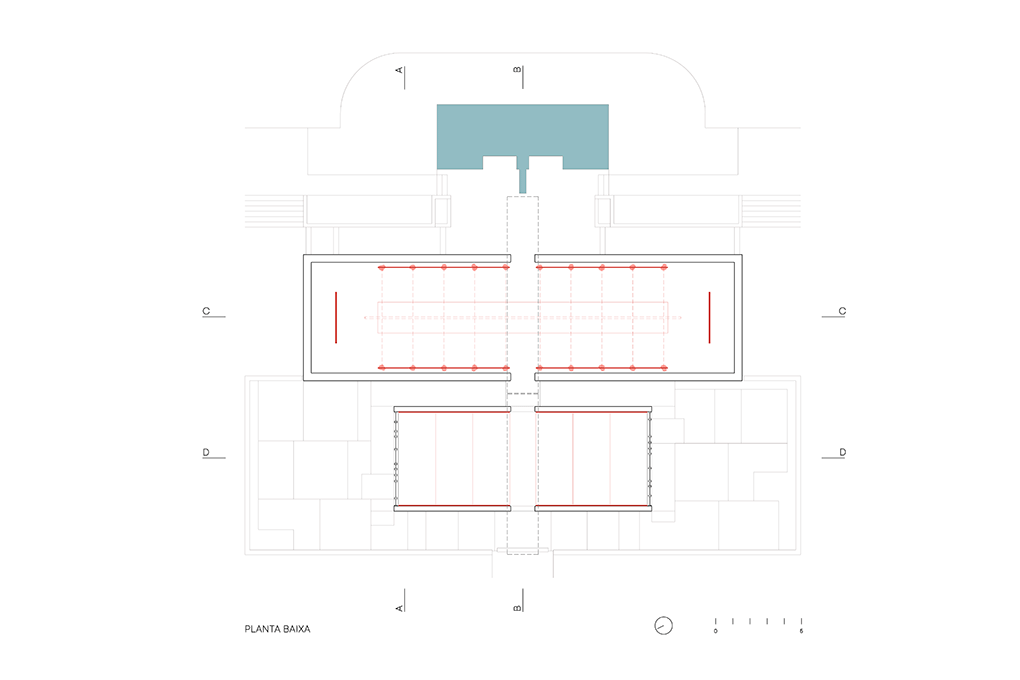
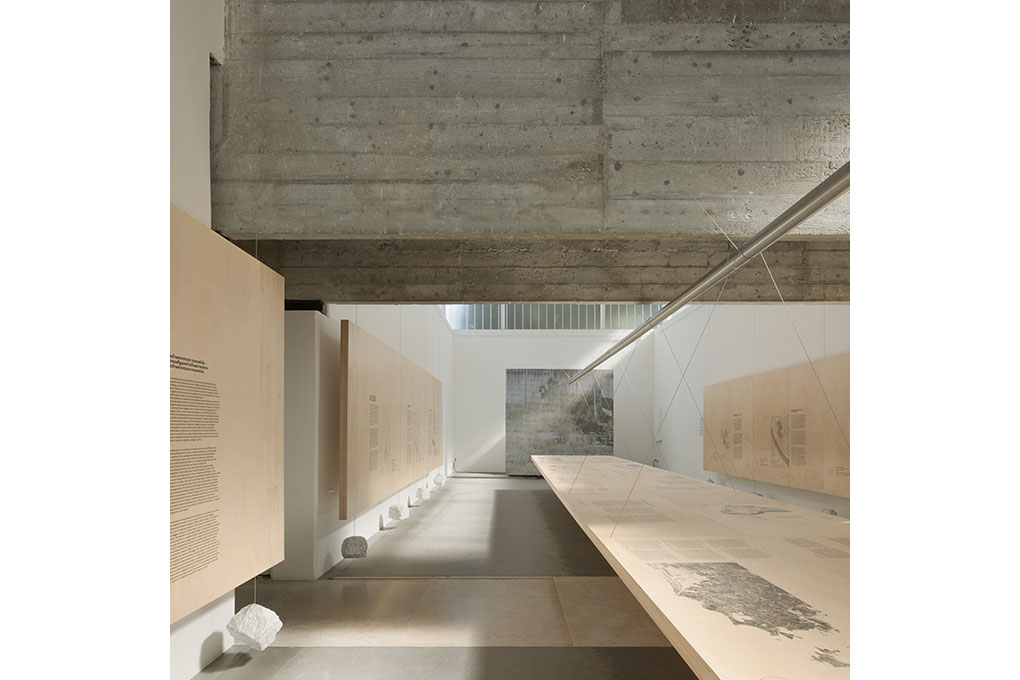
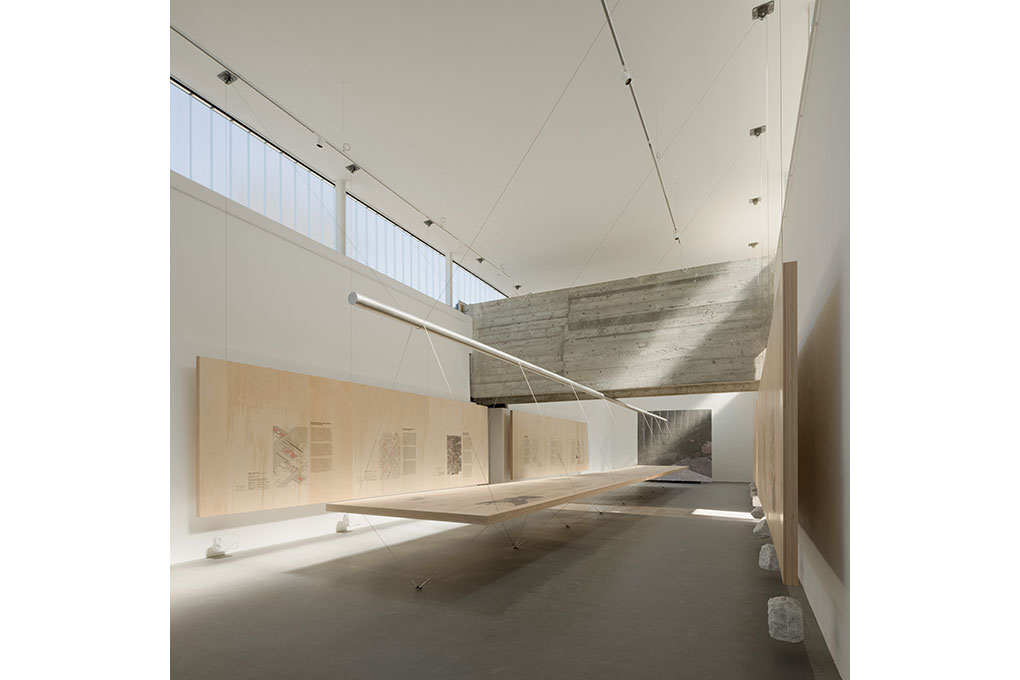
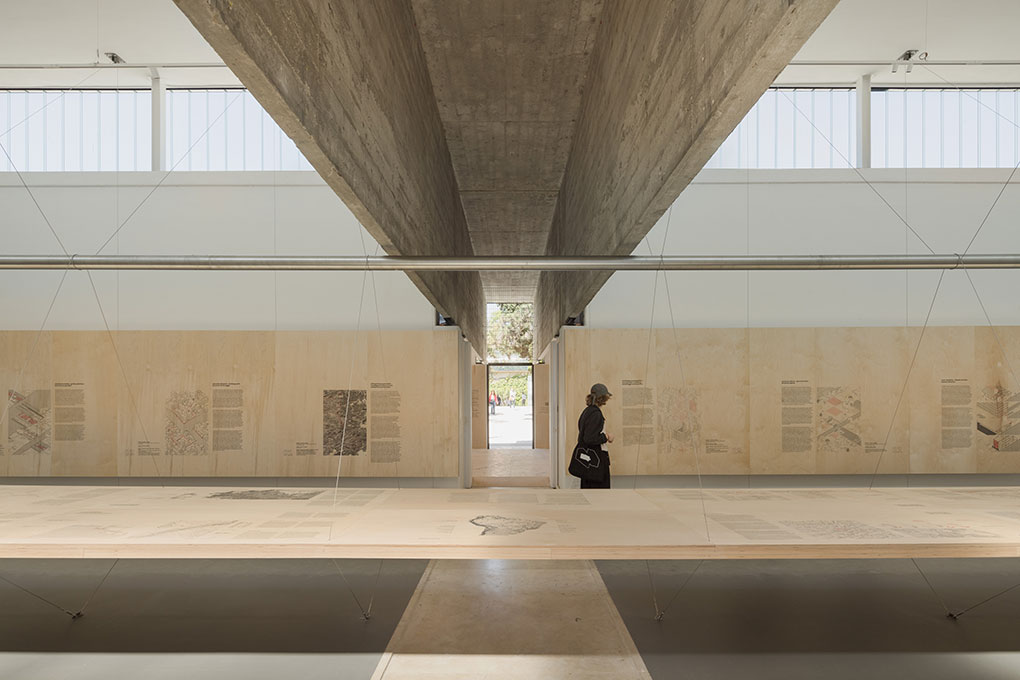
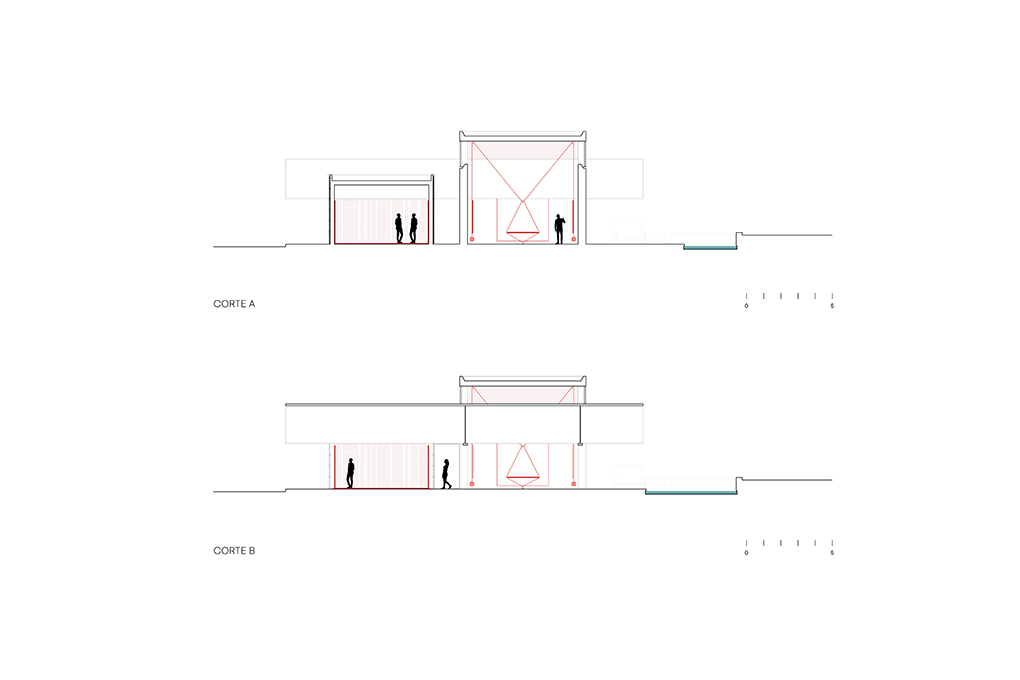
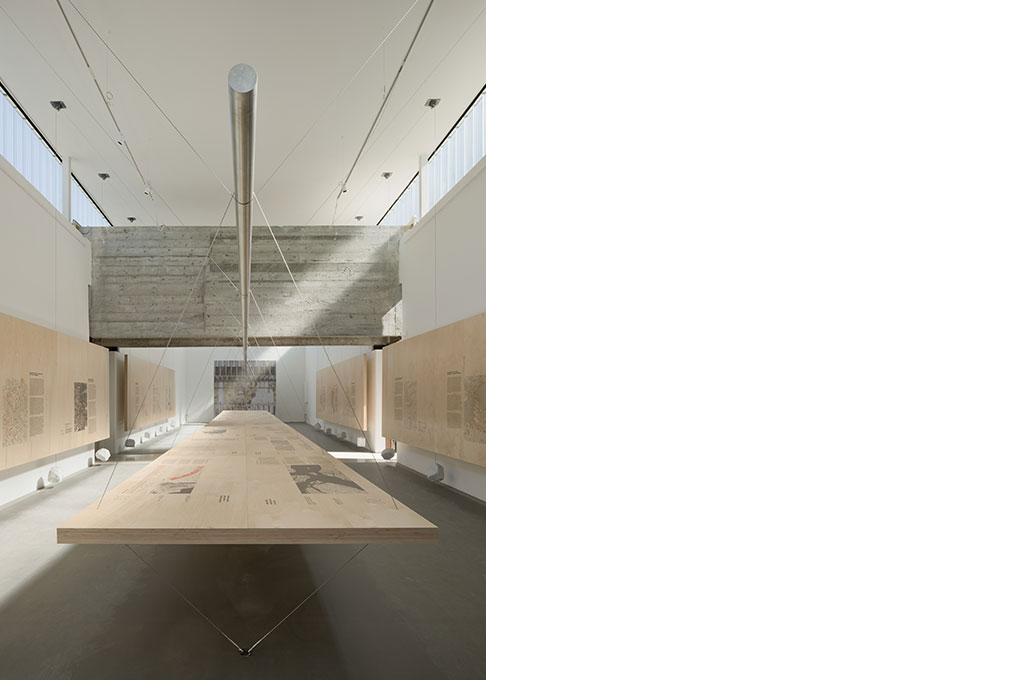
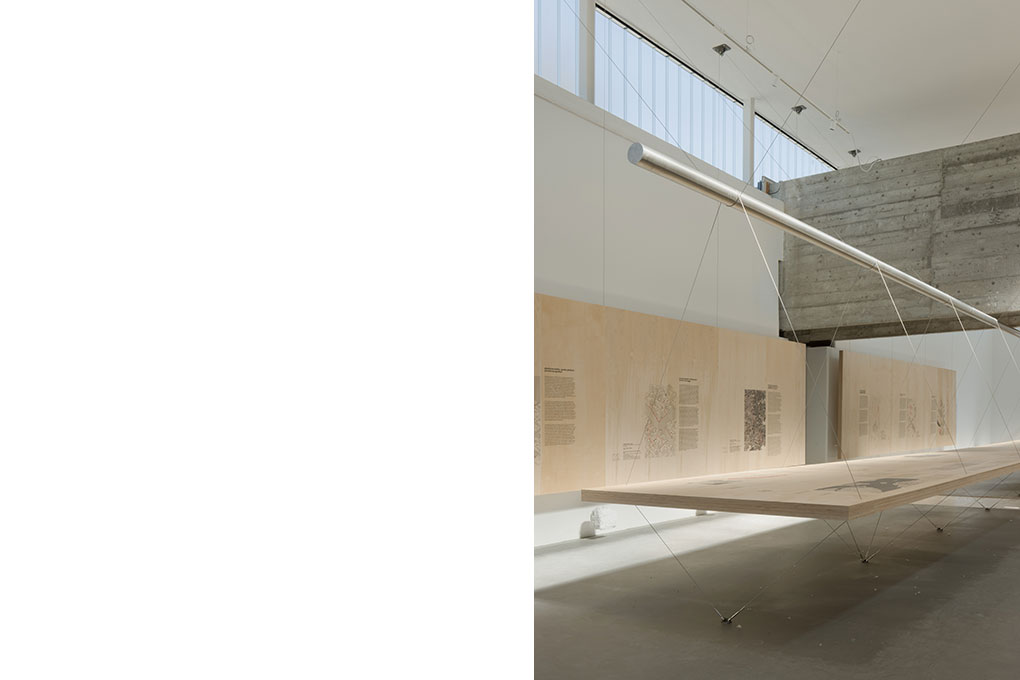
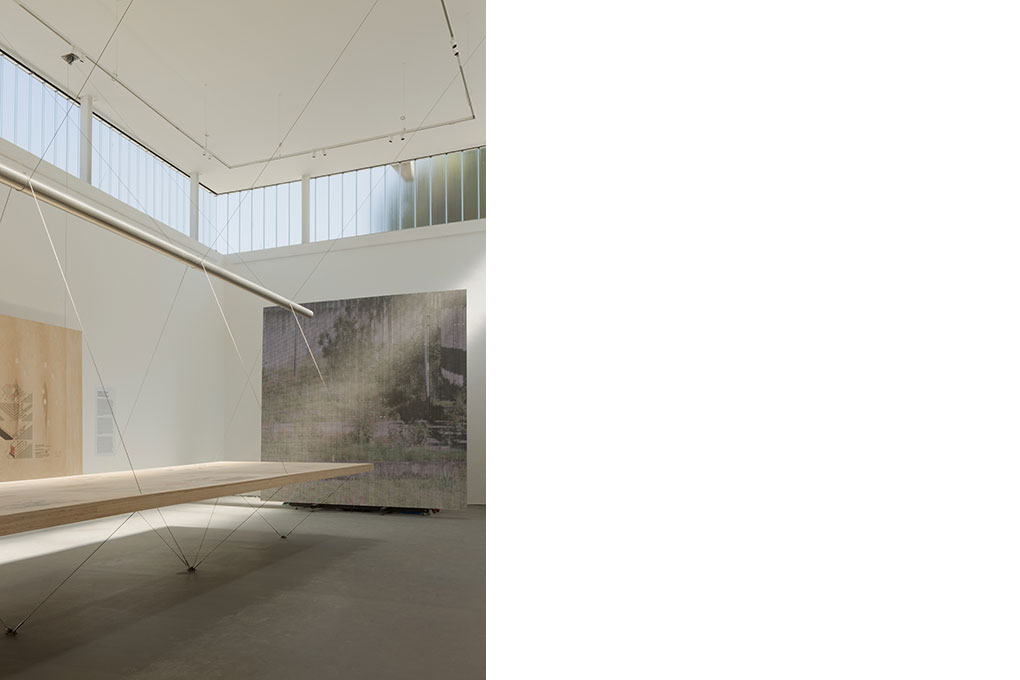
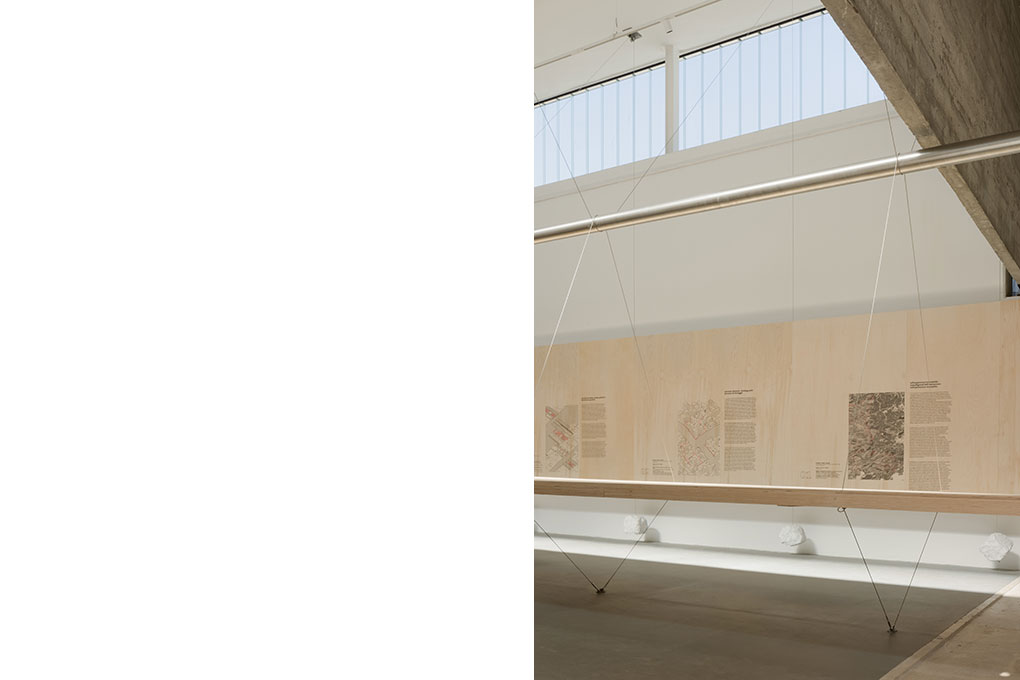
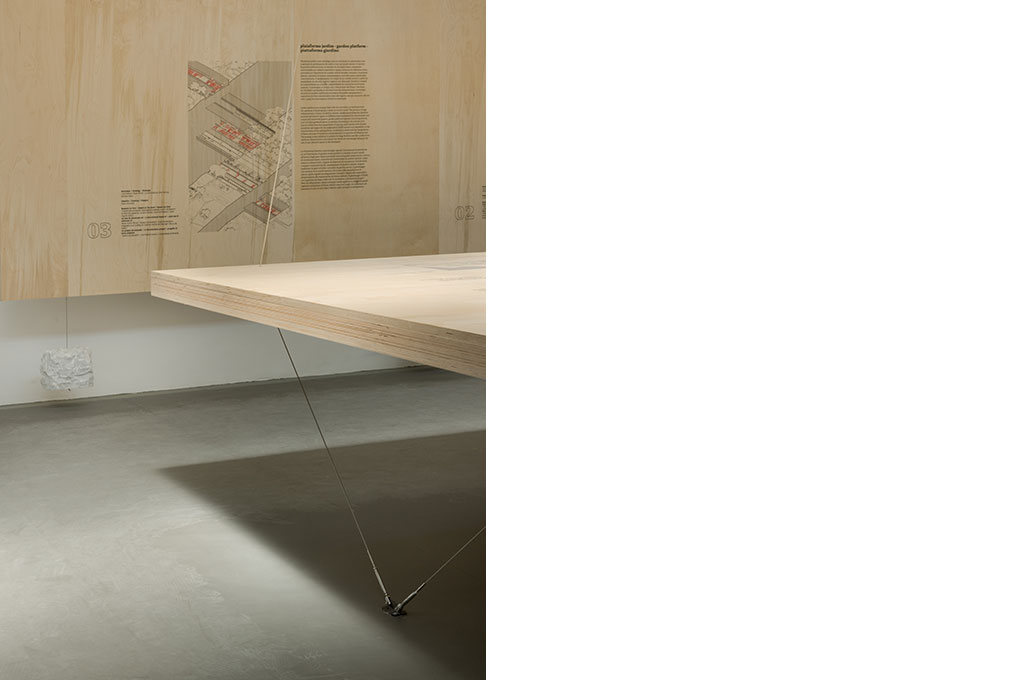
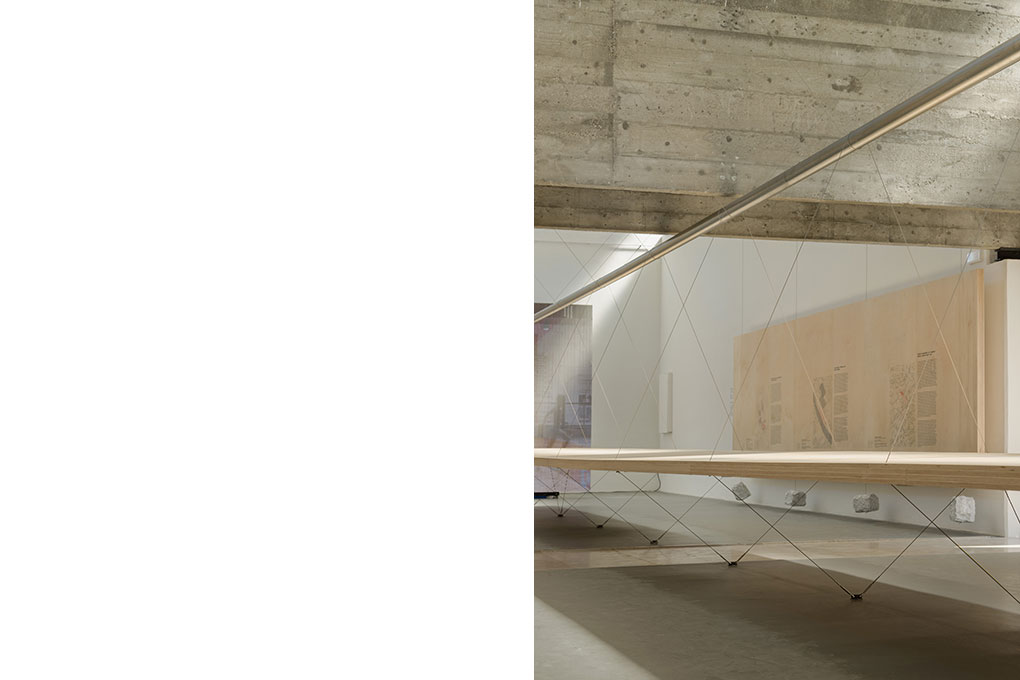
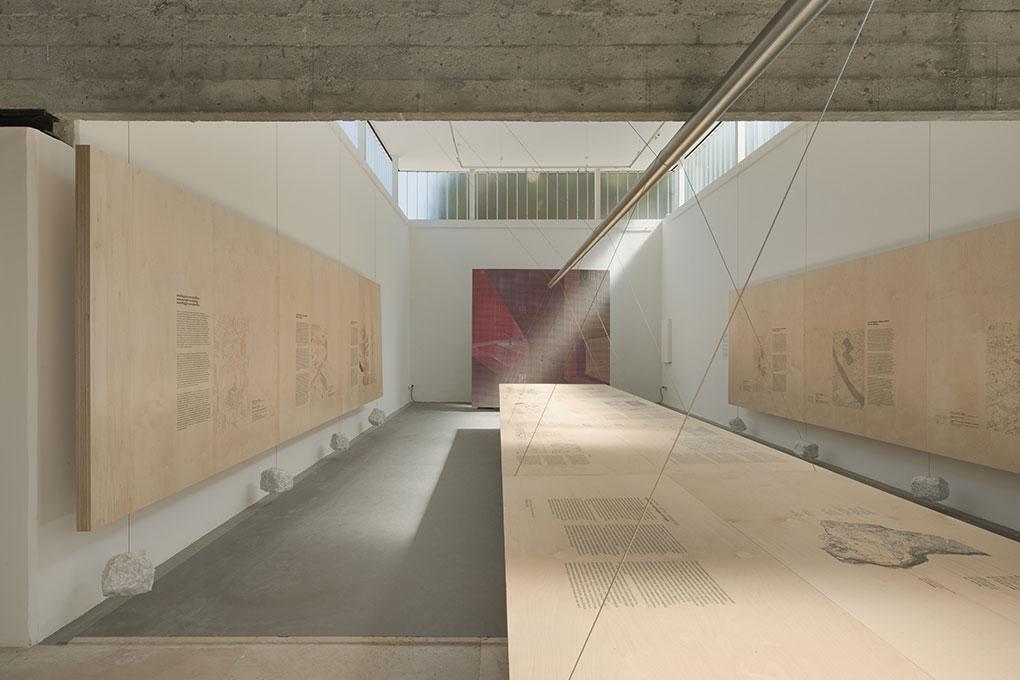
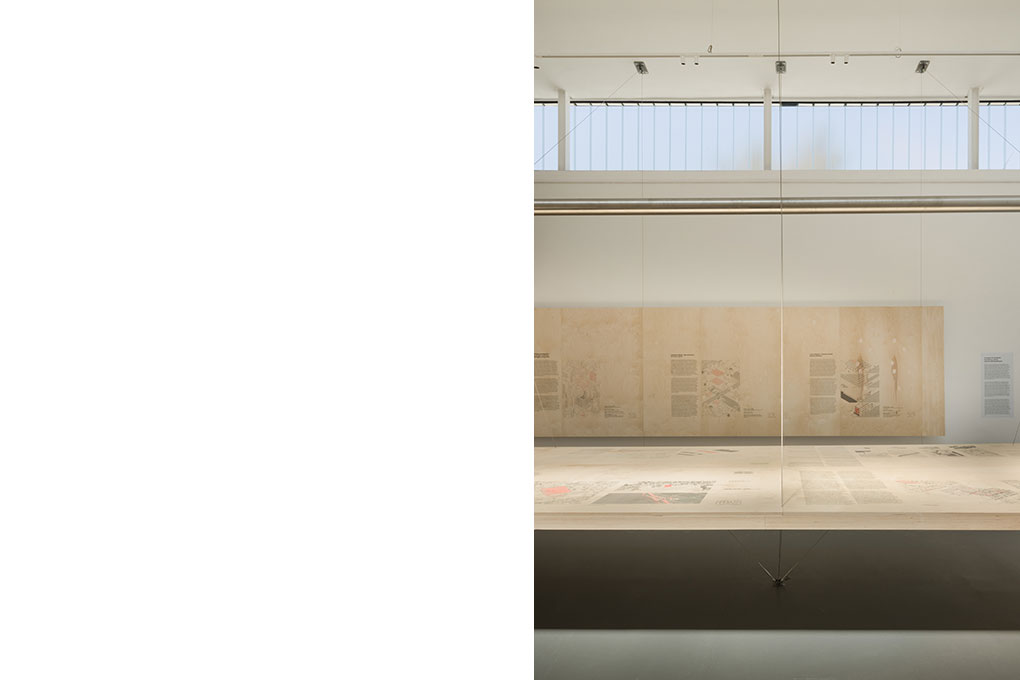
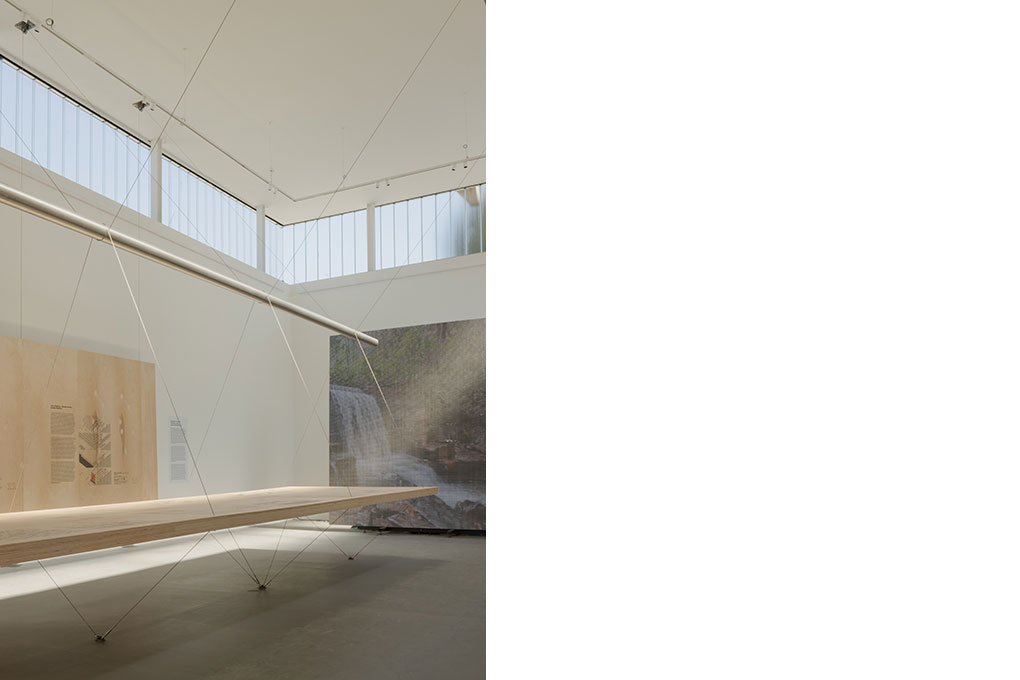
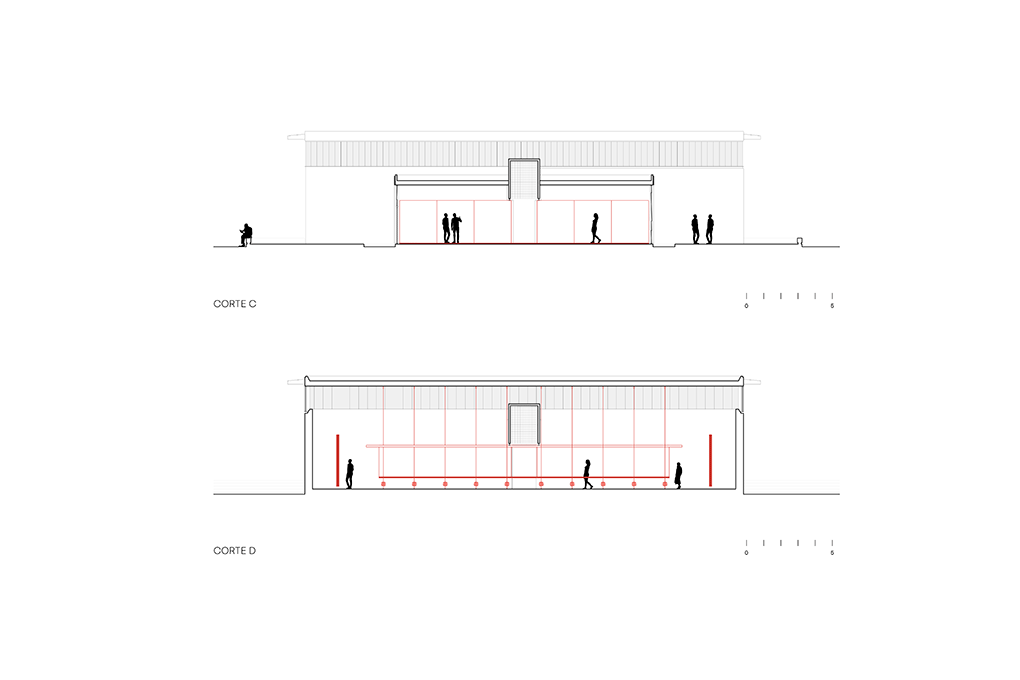
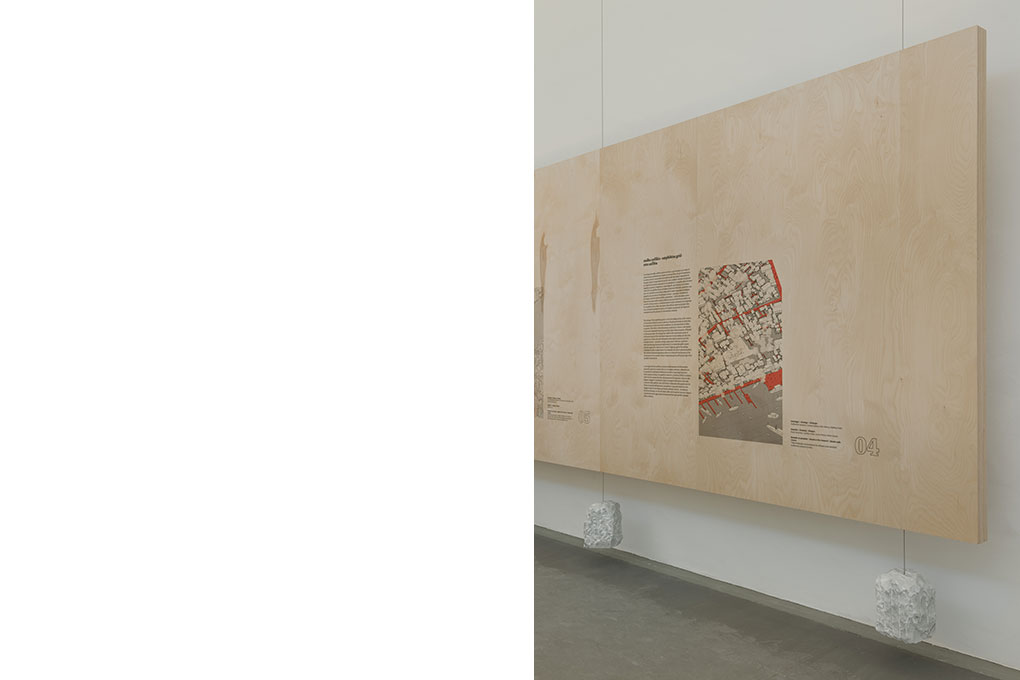
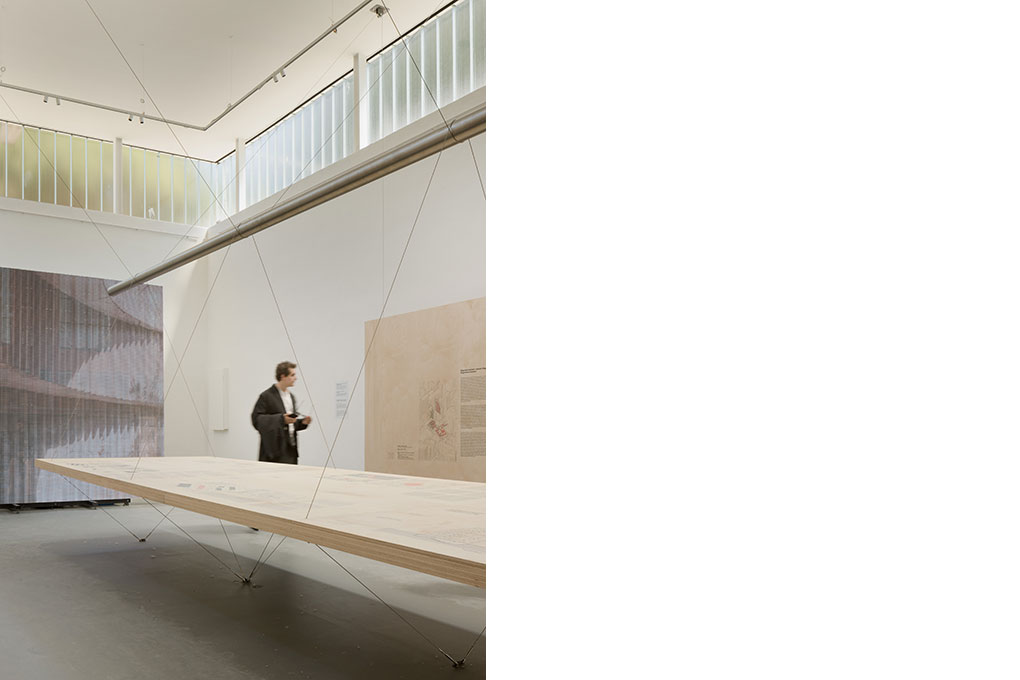
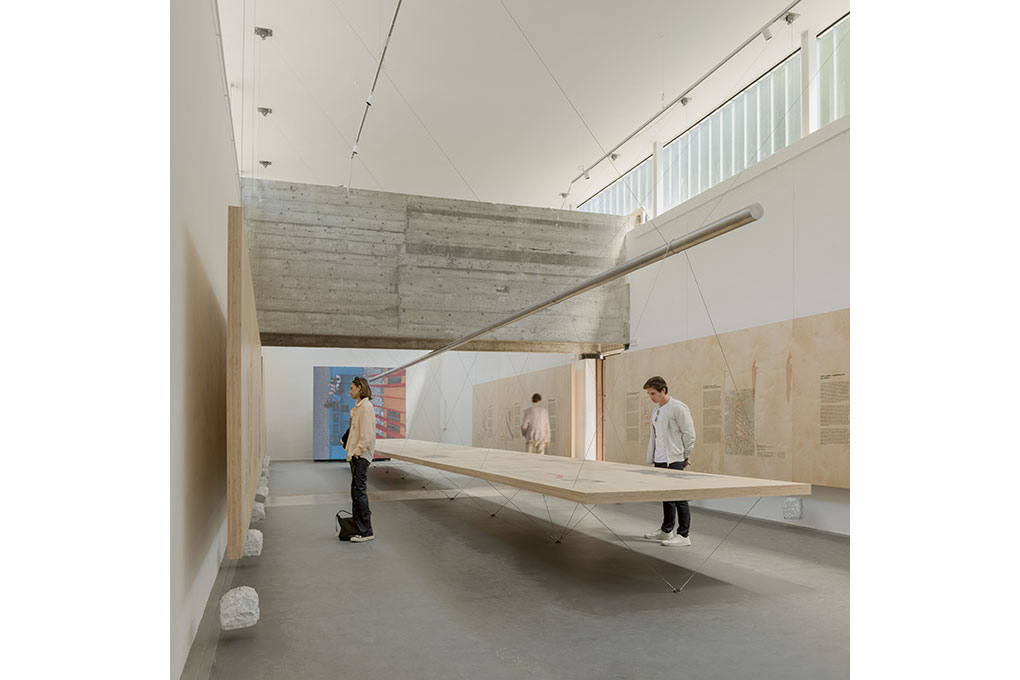
The exhibition space was designed by the curatorial team using minimal elements that employ the structure of the Brazil Pavilion as support to reconfigure its internal spaces. In the first gallery (first act), all installation elements rest on the floor. In the second gallery (second act), the installation is constructed through the equilibrium of wooden panels, stones used as counterweights, and steel cables forming a system that, activated by forces of action and reaction, remains suspended and stable. In this way, the materials used in the installation can be easily reassembled or recycled into new uses after the exhibition.
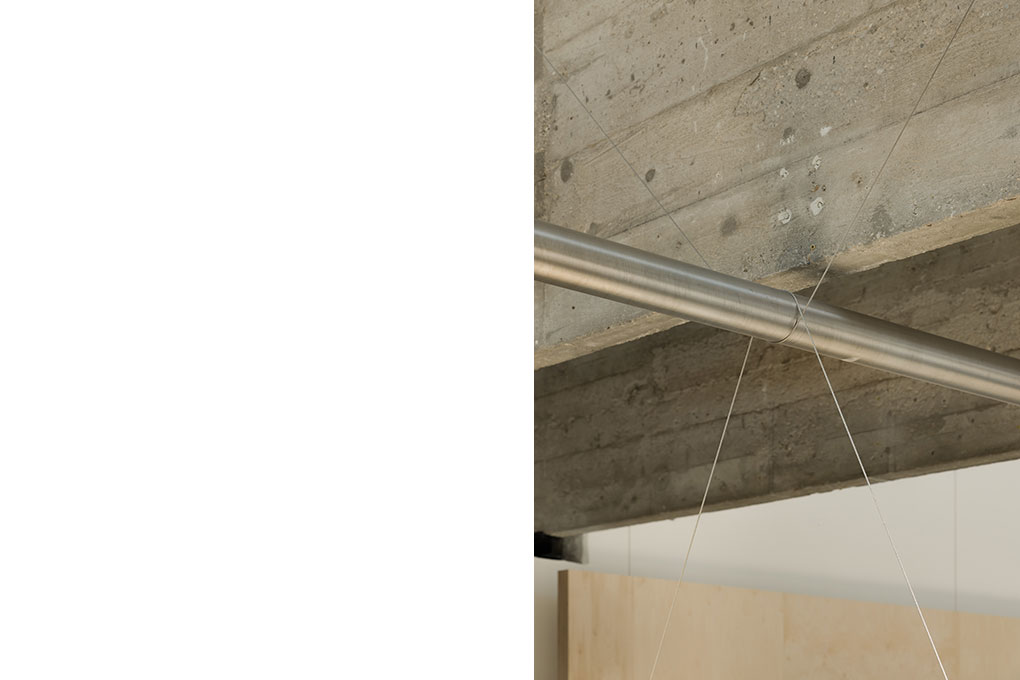
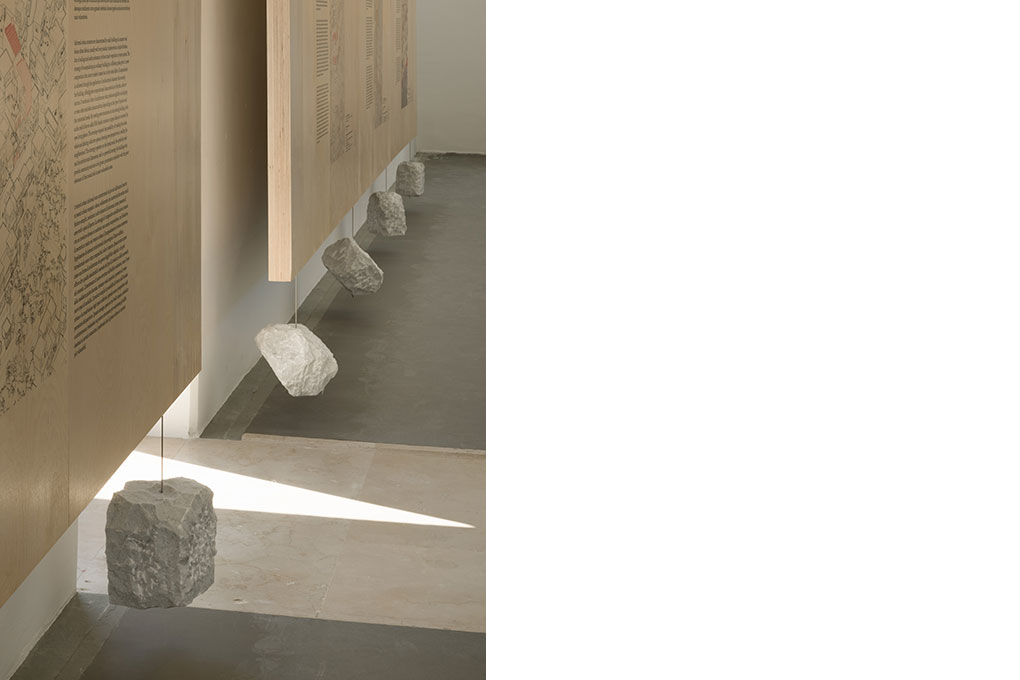
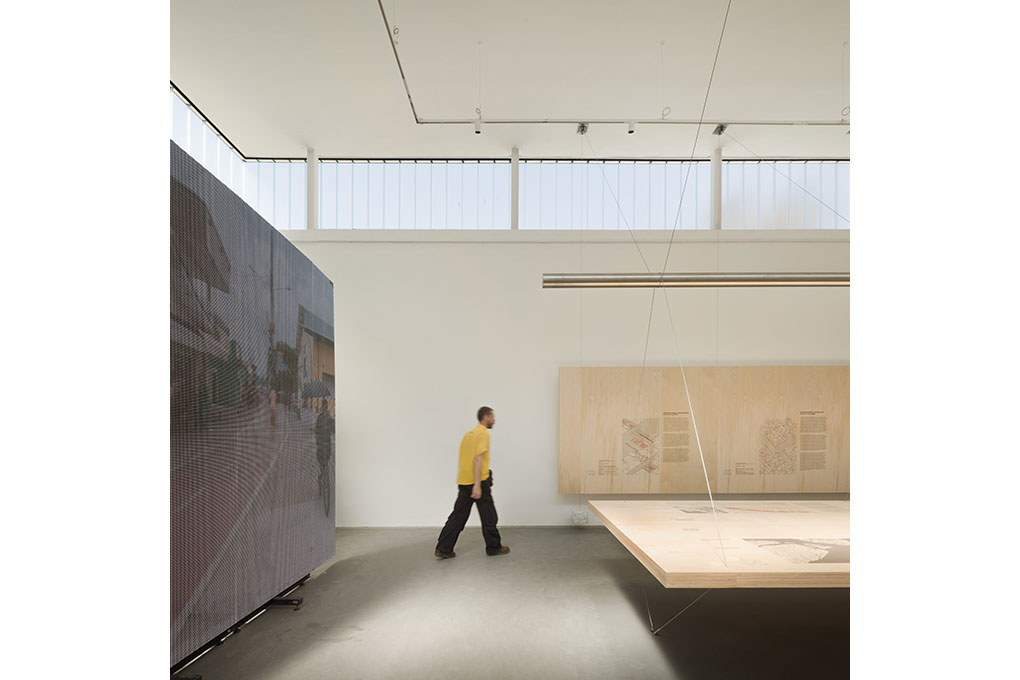
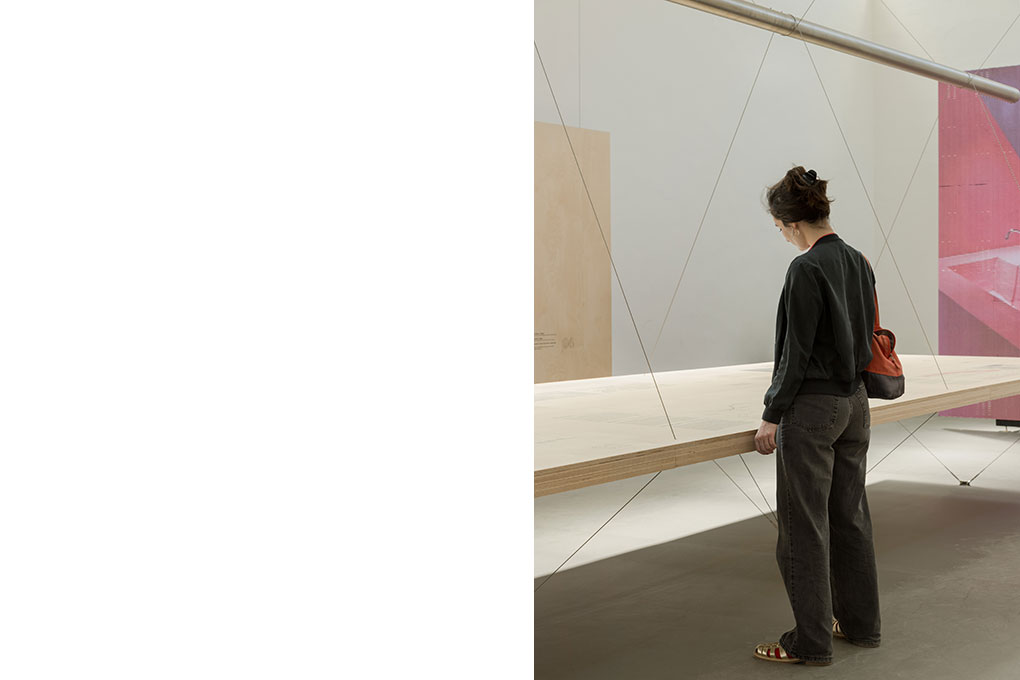
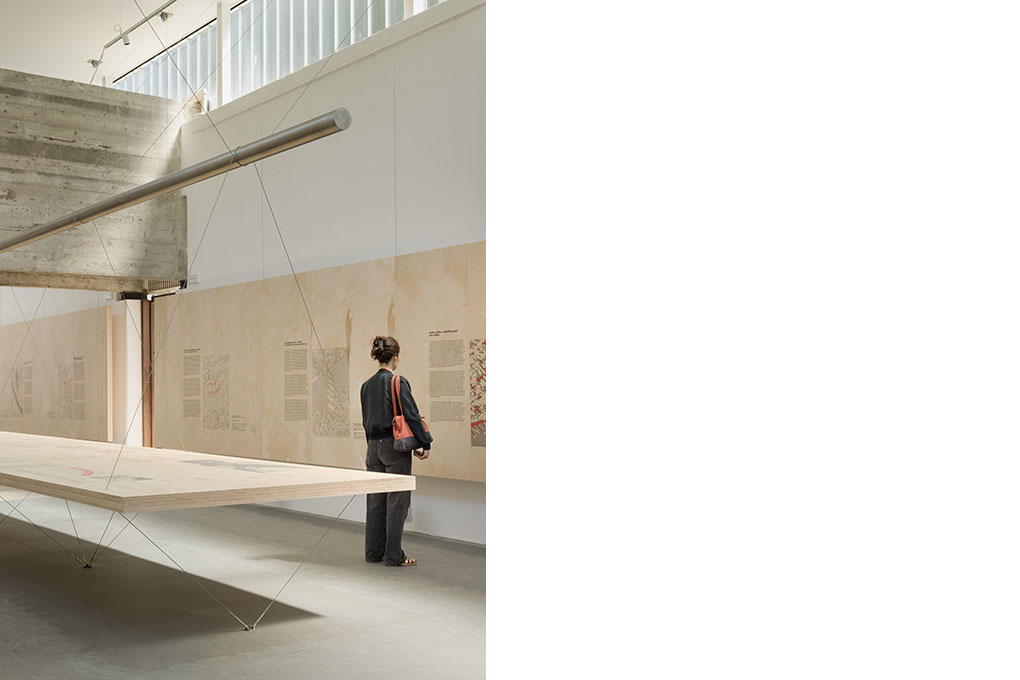
The exhibition system in the second gallery consists of horizontal panels and a table made of reforested plywood, interconnected by tensioned steel cables. Load balance within the system is achieved through marble blocks suspended as counterweights on articulated cables running through pulleys fixed to the ceiling and anchored to a loop secured to the floor. Load transfer is ensured by two steel cables in each panel assembly, which intertwine at the system’s central point around a circular metal tube that distributes tensile forces and stabilizes the structure. Tension in the lower cable results from the redirection of vertical reaction forces toward the floor anchor, allowing the table to counterbalance horizontal forces through compression. Suspended in this manner, the table and panels become a new structural system in themselves, reconfiguring the spatiality of the gallery. The Carrara marble used for the counterweights was chiseled by a local sculptor from larger blocks until reaching a maximum weight of 25 kg per piece.
The Brazil Pavilion in Venice was recently restored through a renovation proposal by Arquitetos Associados and Henrique Penha, as part of the curatorial strategy for the 17th International Architecture Exhibition. Designed in 1960 by architects Henrique Mindlin, Giancarlo Palanti, and Walmir Amaral, the pavilion consists of two exhibition galleries with distinct characteristics. The smaller gallery features large floor-to-ceiling glass panes facing the lateral terraces. The second gallery, in contrast, has no openings at eye level; instead, natural light enters through large, high-level translucent U-glass windows that wrap around the space.
Curators – Plano Coletivo
Luciana Sabioa (FAU-UnB), Eder Alencar (ARQBR), and Matheus Seco (BLOCO Arquitetos)
Collaborators – Plano Coletivo
André Velloso (ARQBR), Carolina Pescatori (FAU-UnB), Cauê Capillé (FAU-UFRJ), Daniel Mangabeira (BLOCO Arquitetos), Guilherme Lassance (FAU-UFRJ), Henrique Coutinho (BLOCO Arquitetos), Sérgio Marques (FAU-UFRGS)
Local Architect (Italy): Eiletz Ortigas
Installation Execution: Creative Up Interiors
Structural Engineering Consulting: Maratá Engenharia
Installation Design Team: Mariana Castro, Victor Itonaga
Content Production Team: Carolina Guida, Isadora Furtado, Isaac Alencar, Jéssica Duarte, João Magnus, Leonardo Nóbrega, Lucas Bandeira, Lucas Freitas, Lucas Marques, Luíza Ceruti, Marcela Peres, Paulo Honorato, Pedro Cardoso, Victor Suarez
Graphic Design – Panels: Lia Tostes
Brazilian Pavilion – Venice International Architecture Biennale 2025
BUILT
VENICE, ITALY, 2025
(RE)INVENTION
The curatorial and exhibition design project for the Brazilian representation at the 19th International Architecture Exhibition – La Biennale di Venezia, originated from the winning proposal submitted by Plano Coletivo, a gorup of which BLOCO is a member, in the competition organized by the Fundação Bienal de São Paulo. The installation occupied the Brazil Pavilion in the Giardini in Venice for six months. The exhibition proposes a reflection based on recent archaeological discoveries of ancestral infrastructures in the Amazonian territory, articulating them with the contradictions and socio-environmental conditions that shape the contemporary city. Structured in two acts, the exhibition (RE)INVENTION builds a narrative that traverses time and territory.
The first act occupies the smaller gallery of the Brazil Pavilion and presents narratives of ancestral Brazil that invite us to reconsider, in light of recent archaeological studies from the Central Amazon, the true age of Brazil’s “inhabited forest.” Approximately 10,000 years ago, since the beginning of the Holocene, Indigenous peoples occupied the lowlands of South America and shaped the surrounding landscapes, creating sophisticated infrastructures that integrated technical knowledge and environmental adaptation strategies. The occupation of this region is therefore as ancient as that of other Amerindian peoples. From the ground itself, earthworks, embankments, retaining walls, and large-scale structures were constructed to shelter thousands of inhabitants. The significant anthropogenic transformations resulting from this occupation established adaptations within nature and produced new landscapes. The Amazon rainforest can thus be understood as the outcome of a balanced coexistence between humans and nature.
The second act occupies the larger gallery of the pavilion and proposes to present design strategies that challenge everyday life in pursuit of social equity and ecological balance in contemporary Brazil, a country shaped by an exceptionally rich natural and urban heritage, born from the promise of development and the desire for cultural emancipation. The focus turns to the possibility of recognizing and valuing design strategies and operations “encapsulated” within the ingenious existing production, inherited and appropriated. Complex yet unequal; useful yet limited: this is our “inherited infrastructure.” The aim is not to recover the image or aesthetic principles of exemplary projects from the past, but rather to update the problem, to hold it in suspension in order to consider contradictions, question the socio-environmental conditions of the contemporary city, and present possibilities for learning and action in the face of future challenges. What lessons, in terms of relevance and meaning, can be drawn from the relationship between this infrastructural built heritage and natural heritage?
Exhibition Installation Concept
The exhibition space was designed by the curatorial team using minimal elements that employ the structure of the Brazil Pavilion as support to reconfigure its internal spaces. In the first gallery (first act), all installation elements rest on the floor. In the second gallery (second act), the installation is constructed through the equilibrium of wooden panels, stones used as counterweights, and steel cables forming a system that, activated by forces of action and reaction, remains suspended and stable. In this way, the materials used in the installation can be easily reassembled or recycled into new uses after the exhibition.
The exhibition system in the second gallery consists of horizontal panels and a table made of reforested plywood, interconnected by tensioned steel cables. Load balance within the system is achieved through marble blocks suspended as counterweights on articulated cables running through pulleys fixed to the ceiling and anchored to a loop secured to the floor. Load transfer is ensured by two steel cables in each panel assembly, which intertwine at the system’s central point around a circular metal tube that distributes tensile forces and stabilizes the structure. Tension in the lower cable results from the redirection of vertical reaction forces toward the floor anchor, allowing the table to counterbalance horizontal forces through compression. Suspended in this manner, the table and panels become a new structural system in themselves, reconfiguring the spatiality of the gallery. The Carrara marble used for the counterweights was chiseled by a local sculptor from larger blocks until reaching a maximum weight of 25 kg per piece.
The Brazil Pavilion in Venice was recently restored through a renovation proposal by Arquitetos Associados and Henrique Penha, as part of the curatorial strategy for the 17th International Architecture Exhibition. Designed in 1960 by architects Henrique Mindlin, Giancarlo Palanti, and Walmir Amaral, the pavilion consists of two exhibition galleries with distinct characteristics. The smaller gallery features large floor-to-ceiling glass panes facing the lateral terraces. The second gallery, in contrast, has no openings at eye level; instead, natural light enters through large, high-level translucent U-glass windows that wrap around the space.
Curators – Plano Coletivo
Luciana Sabioa (FAU-UnB), Eder Alencar (ARQBR), and Matheus Seco (BLOCO Arquitetos)
Collaborators – Plano Coletivo
André Velloso (ARQBR), Carolina Pescatori (FAU-UnB), Cauê Capillé (FAU-UFRJ), Daniel Mangabeira (BLOCO Arquitetos), Guilherme Lassance (FAU-UFRJ), Henrique Coutinho (BLOCO Arquitetos), Sérgio Marques (FAU-UFRGS)
Local Architect (Italy): Eiletz Ortigas
Installation Execution: Creative Up Interiors
Structural Engineering Consulting: Maratá Engenharia
Installation Design Team: Mariana Castro, Victor Itonaga
Content Production Team: Carolina Guida, Isadora Furtado, Isaac Alencar, Jéssica Duarte, João Magnus, Leonardo Nóbrega, Lucas Bandeira, Lucas Freitas, Lucas Marques, Luíza Ceruti, Marcela Peres, Paulo Honorato, Pedro Cardoso, Victor Suarez
Graphic Design – Panels: Lia Tostes